

Many golfers proudly collect data after every round. They know how many fairways they hit, how many putts they took, and what their average score is from 100 meters.
But when asked, “What have you changed in your practice based on those numbers?” — they’re often silent.
The truth is, stats are useless unless they lead to action. As Robin puts it:
“You’re not practicing to feel good. You’re practicing to fix measured weaknesses.”
So how do you go from collecting numbers to training smarter? It’s not about doing more. It’s about practicing what actually moves the needle on your scorecard.
Step 1: Review Your Stats Properly (Every 5–10 Rounds)
One round doesn’t tell you much. A handful of bad shots doesn’t equal a swing flaw. That’s why it’s critical to step back every 5 to 10 rounds and look for patterns, not one-off mistakes.
Are you consistently leaving your approach shots short from certain distances?
Are most of your missed putts coming from a specific range?
Do you tend to score worse on Par 3s than Par 5s?
This type of trend-spotting helps you see where you’re repeatedly leaking strokes. And once you spot those leaks, you can target them with purpose.
Step 2: Choose One or Two Clear Priorities
The biggest mistake after a stats review? Trying to fix everything at once.
If your takeaway is “I need to work on my putting, driving, wedges, and course management,” you’re going to get overwhelmed — and probably change nothing.
Instead, focus on one or two specific weaknesses.
For example, say your data shows that:
You now have two clear areas to work on:
From there, you can plan a focused practice week that’s actually rooted in measured needs, not feelings or guesswork.
Step 3: Create Intentional, Personalized Practice Sessions
Once you’ve chosen your priorities, your practice needs to be structured to solve those exact problems.
Let’s take the wedge example. You don’t just hit “some” wedges. You might design a session where you:
For putting, instead of hitting random 10-footers, you could:
These sessions don’t just build skill — they create feedback loops. They let you measure your progress, adjust your focus, and stay locked in on what actually improves your score.
Step 4: Track Progress Over Time (and Be Ready to Adjust)
A good training plan isn’t set in stone. It evolves.
If you’ve been working on your wedges for three weeks, and your stats now show a closer average distance to the flag — great. You’ve made progress. That area might no longer be your biggest leak.
But maybe now your stats reveal a new issue: missed up-and-downs from just off the green.
So, your plan shifts. The goal is to always be working on the area where you’re losing the most strokes, not just repeating what you’ve already improved.
That’s what Robin means when he says:
“A useful training plan is a living plan — something that evolves with your scorecards.”
Avoid This Trap: Only Practicing What You’re Already Good At
Let’s be honest. Most of us practice what feels good.
We hit drives because we like the sound. We sink short putts because it builds confidence. We do what makes us comfortable.
But real progress doesn’t live in comfort.
Robin puts it clearly:
“We all tend to train what we’re already good at. But real progress comes from targeting the areas where you’re actually losing strokes — and for that, you need stats.”
Your game may feel solid, but your data might be screaming that you’re dropping three shots per round on short wedges or lag putting.
Once you see the numbers, you can’t unsee them. That’s your roadmap.
Stats Aren’t Just Numbers — They’re Direction
So what does it actually look like to train smarter?
Imagine this:
You review your last 10 rounds and spot two weaknesses:
You build a week of practice that includes:
By the end of the week, you know:
And next week, you adjust again.
This is what it means to have a feedback loop in your golf practice. Data → Focus → Action → Review → Repeat.
When Golf Practice Becomes Precision Training
The shift here is simple, but powerful.
You’re no longer training just to “get reps.” You’re training to close scoring gaps. You know exactly where your game is costing you — and you have a plan to fix it.
You don’t need more hours. You need smarter hours.
You’re no longer hoping to improve.
You’re building your improvement.
Final Thought: Let Your Stats Drive the Practice, Not Your Ego
Paul summed it up with the right question:
“So would you say that effective practice isn’t about working on what you like, but what the stats tell you to work on?”
Robin’s response?
“Exactly.”
That’s the mindset shift.
Golf practice isn’t about what feels good. It’s about what works.
And there’s no better guide than your own performance data — if you’re willing to listen to it.

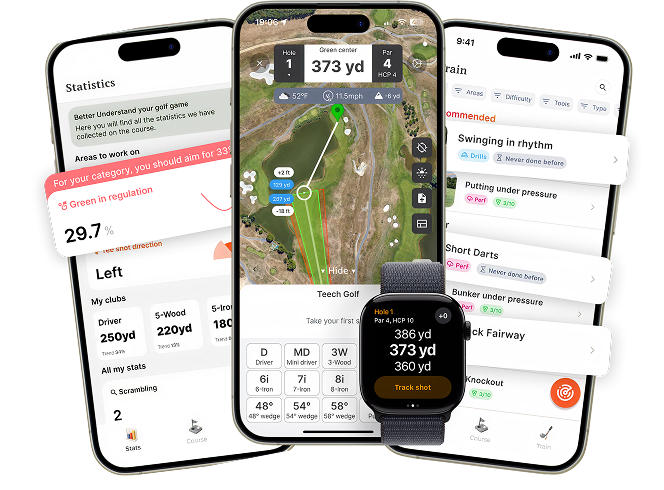
We analyze your golf statistics and performance data to tell you exactly what to work on to improve your game faster.
 Download app - free
Passionate golfer and co-founder of Teech Golf. My mission with Teech is to build technology that becomes a true companion in helping you improve your game.