

A dogleg is a hole — usually a par 4 or par 5 — that bends to the left or right, instead of going straight to the green.
Imagine standing on the tee box and seeing the fairway curve around trees, bunkers, or water. You might not even see the green from where you stand. That’s classic dogleg territory.
This kind of design forces you to make decisions right from the tee:
Doglegs demand more than just good ball striking. They require strategic thinking, distance awareness, and confidence in your line.
Most golfers make the mistake of picking a side of the fairway randomly — or just aiming for the widest part. But there’s a smarter way.
Use the pin position on the green to decide your tee shot line.
Here’s why:
Same logic applies to doglegs left, just flipped:
Always check pin position before teeing off on a dogleg. Your approach angle starts with your drive.
One of the biggest mistakes on doglegs? Overhitting your tee shot without knowing the layout.
If you hit it too far or in the wrong direction:
Golden rule: Only try to carry the corner if you know the exact distance and your carry yardages.
It’s tempting. The dogleg dares you to take the shortcut. And sometimes — it’s worth it.
But here’s the truth: Cutting the corner only makes sense if several key conditions are met.
✅ There’s no serious danger in the corner (no trees, water, out of bounds)
✅ You have enough carry distance and ball height to clear the corner
✅ You know your precise line of play — and can visualize it
✅ You’re willing to accept the risk of a bad lie or a blocked approach if it fails
If all of these are true, go ahead and take the aggressive line.
But if not? Play smart. A well-placed shot short of the corner often sets up an easier approach than a risky attempt that ends up in trouble.
Doglegs become much easier when you approach them with a repeatable thought process.
The flag determines your ideal angle of attack — and that starts from the tee box.
Use your GPS or course map. Don’t guess. Control your tee shot yardage accordingly.
A bold shot can pay off — but only when it’s calculated, not reckless.
Good strategy on doglegs starts from the green and works backward. Where do you want to be hitting your second shot from?
Doglegs can be confusing, especially when you can’t see the green or the fairway bends around hazards. But with the right approach, they’re actually a chance to gain strokes, not lose them.
So next time you step onto a tee box and face a fairway that bends out of sight, don’t panic. Ask yourself:
“Where’s the flag? What’s my best angle? And how far should I hit?”
Answer those, and you’ll be the one turning tricky holes into birdie chances.

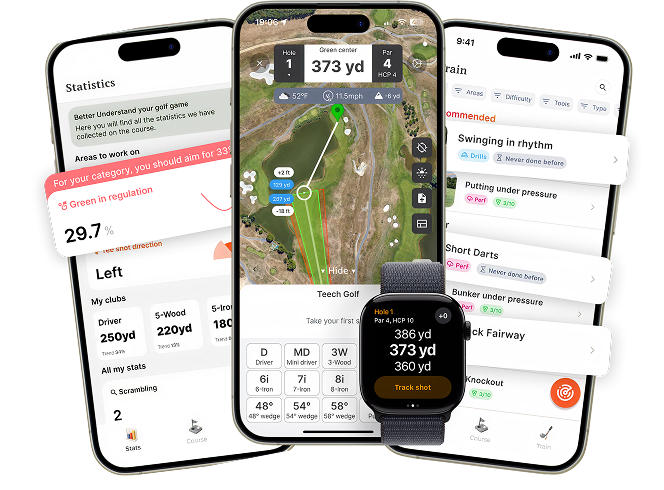
We analyze your golf statistics and performance data to tell you exactly what to work on to improve your game faster.
 Download app - free
Passionate golfer and co-founder of Teech Golf. My mission with Teech is to build technology that becomes a true companion in helping you improve your game.