

Let’s be honest: when you think about improving your golf game, your first thought is probably “How can I make more birdies?”
But here’s the reality: for most amateur golfers, birdies don’t lower your scores — avoiding blow-ups does.
You don’t need to play perfect golf. You just need to stay out of trouble and eliminate the major mistakes that lead to double bogeys or worse.
And thanks to performance data from thousands of amateur rounds, we now know exactly what those mistakes are — and how you can prevent them.
One of the most eye-opening insights from amateur performance analysis is this:
The higher your handicap, the more every small mistake turns into a big number.
While pros and low-handicap players can recover from a missed fairway or a poor chip, mid- to high-handicappers often turn small errors into double or triple bogeys.
Let’s break down the five most common causes of double bogeys, based on amateur data.
Now that you know where most double bogeys come from, let’s talk about how to avoid them.
Your goal is not to hit the perfect fairway. Your goal is to stay in play.
✅ A tee shot in light rough is 100x better than a ball in the water or out of bounds.
If the pin is tucked behind a bunker or near water, ask yourself: “Is it worth the risk?”
🎯 A 30-foot putt is never worse than a penalty stroke.
One of the fastest ways to ruin a hole is trying to play a “highlight-reel” chip and flubbing it.
Make it your mission to get the ball on the green — even if it’s not close.
🧠 The goal is simple: make sure your next shot is a putt.
Three-putts often come from bad distance control, not poor aim.
Before every round:
During the round:
⛳ A confident two-putt from 40 feet is a mini victory.
If you’re not confident from the sand, don’t aim for tight pins or tricky carries.
And if you’re struggling from bunkers regularly — invest in technique. A few tips or drills can transform this part of your game.
Here’s what low-handicap players do better than most:
They avoid compounding mistakes.
They don’t chase birdies. They avoid doubles.
They make smart choices when they’re out of position. They take their medicine. They get back into play. And they play defense when it matters.
That’s what real scoring is — not shotmaking, but mistake management.
If you play regularly, start tracking a few basic things after each round:
This personal data can show you your own version of the “Top 5 Mistakes” — and once you know where your biggest leaks are, you can plug them with targeted practice.
Every golfer, no matter their level, will hit poor shots. That’s part of the game.
But double bogeys and blow-up holes don’t have to be the result.
If you can:
Then you’ll protect your score, even on days when your swing isn’t perfect.
Forget chasing birdies for now.
Start by eliminating the disasters — and watch your handicap drop.

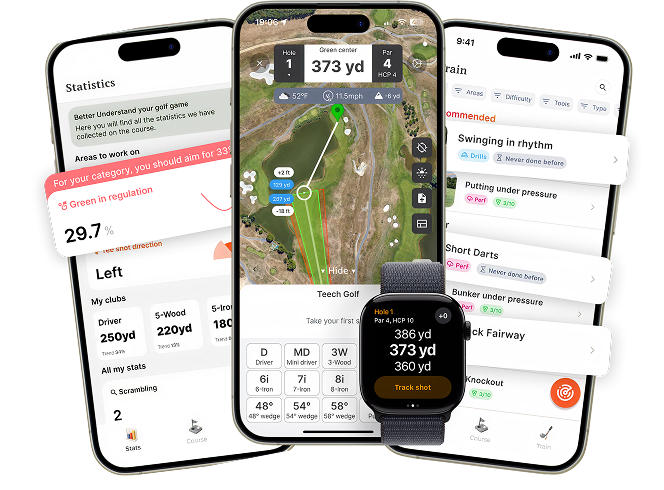
We analyze your golf statistics and performance data to tell you exactly what to work on to improve your game faster.
 Download app - free
Passionate golfer and co-founder of Teech Golf. My mission with Teech is to build technology that becomes a true companion in helping you improve your game.