

It’s no secret: golfers love to talk about how far they hit the ball.
Launch monitors, YouTube videos, swing speed training…
Distance is everywhere.
And while hitting it long can absolutely help your game — especially off the tee — it’s not just about raw power. There’s a technical side to distance that most amateurs overlook.
Let’s dive into what actually creates longer drives — and how to make sure you’re chasing distance the right way.
Of all the clubs in your bag, your driver is the longest — which means it also generates the most speed.
But that speed comes with a trade-off:
More speed = more variables to control.
When you swing your driver at 90–110 mph (or more), even the smallest timing issue or misalignment in your setup can create a big miss.
🎯 The result: even a fast swing doesn’t guarantee distance or accuracy.
This is where proper driver fitting becomes essential — especially when it comes to your shaft.
…can help deliver the clubface squarely to the ball, without twisting at impact.
If the shaft is too soft or too stiff, it’ll flex at the wrong time — and your face angle will suffer.
✅ A well-fit driver won’t just improve distance — it will improve consistency and confidence off the tee.
You’ve probably heard people say, “I hit a fade” or “I draw the ball.”
But when you dig into the mechanics, there are 11 possible ball flights based on face angle, swing path, and impact geometry — not including height.
You don’t need to memorize all of them, but knowing that your swing creates predictable patterns helps you:
💡 And if you’re consistently hitting pull-slices? There’s a good chance your face is closing too early, or your shaft isn’t matched to your motion.
Let’s get practical.
Maximize your clubhead speed at impact — not before, not after — while maintaining control over:
Swinging too hard at the top of the downswing.
This leads to:
Focus all your speed and energy on a 10 cm window around the ball — from 5 cm before impact to 5 cm after.
Imagine that you’re trying to sweep through that zone as fast and cleanly as possible — not hit the ball itself.
✅ Why it works: You naturally delay your speed peak until it counts — at and through the strike zone.
This simple drill trains better rhythm and more efficient energy transfer, which leads to more distance without overswinging.
Let’s pause for a reality check.
That’s because raw distance doesn’t guarantee better scores.
It only helps if it leads to better positions:
Trying to copy the big hitter in your group — especially if their swing doesn’t match your body or tempo — often leads to wild misses and big numbers.
🔑 The goal is controlled distance, not just more distance.
Whether you’re chasing yards or just trying to hit more fairways, here’s how to get the most from your driver:
Even a basic fitting can reveal mismatches in flex, weight, or kick point.
Use overspeed training tools or light resistance bands to build speed gradually.
Drill the “impact zone” concept: 5 cm before and after the ball.
Smooth is powerful. Acceleration doesn’t mean rushing.
Hit the club that keeps you in play — even if it’s not the driver.
Golf is a game of balance.
Yes — distance can help.
Yes — speed matters.
But in the end, the player who:
…will always beat the one chasing highlight-reel drives with inconsistent results.
So train for speed. Work on your technique. But above all?
Play your game. Your swing, your tempo, your strengths.
That’s the real path to better golf — and lower scores.

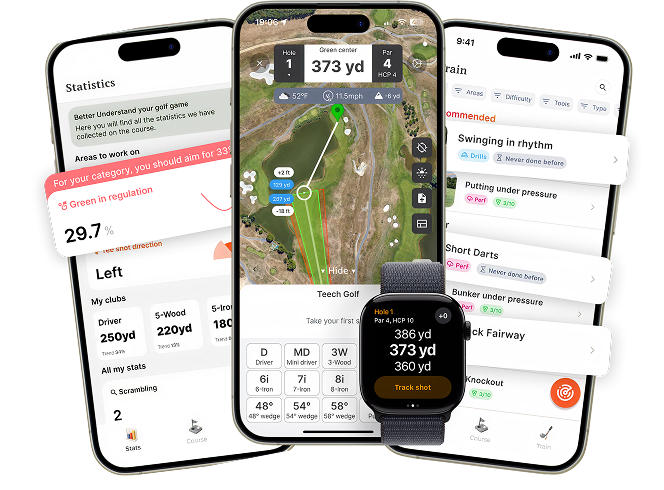
We analyze your golf statistics and performance data to tell you exactly what to work on to improve your game faster.
 Download app - free
Passionate golfer and co-founder of Teech Golf. My mission with Teech is to build technology that becomes a true companion in helping you improve your game.