
Missing on the correct side of the green is one of those overlooked details that can make or break your round. In amateur golf, many bad scores don’t come from bad swings, but from bad decisions. And a classic example of this? Missing the green on the wrong side while chasing the flag.
Let’s dive into a core course management concept: understanding the difference between the short side and the fat side — and why aiming for the larger, safer area of the green is usually the smarter play, even when it feels counterintuitive.
Understanding the Difference Between Short Side and Fat Side
Short side refers to the part of the green closest to the flag — in any direction. Missing here leaves you with:
Unless your short game is tour-level, this leads to more bogeys and double bogeys than you’d like to admit.
On the other hand, the fat side is the opposite — the side of the green furthest from the pin. It might seem conservative, but it’s strategic:
Targeting this area consistently helps you stay in control, avoid big mistakes, and make more pars (and stress-free bogeys at worst).
Why Aiming for the Fat Side Improves Your Scores
It Significantly Reduces Risk
Playing to the short side demands perfection. Most golfers, even skilled ones, can’t deliver that consistently. By targeting the fat side, you eliminate those high-risk shots around the green that wreck your scorecard:
It Boosts Your GIR and Approach-Putt Stats
When you aim for the bigger part of the green, your chance of hitting it (Greens in Regulation — GIR) goes up. Even if your ball doesn’t land perfectly, you’re still often on or near the green with:
Statistically, this mindset improves your approach-putt numbers: fewer strokes wasted around the green.
Top Players Don’t Chase Pins
Case Study: Scottie Scheffler’s Approach
Take world-class player Scottie Scheffler as an example. One reason he dominates on the PGA Tour isn’t just raw power or putting magic. It’s strategic brilliance.
Scheffler rarely short-sides himself. Instead, he deliberately aims for:
Yes, this sometimes leaves him with a 10-meter putt — but rarely a chip out of thick rough or a downhill flop shot under pressure. This translates into:
Amateurs Can Learn from This
You don’t need Scheffler’s swing to apply this strategy. In fact, especially as an amateur, this tactic is more impactful for you. Remember: your goal isn’t to shoot 65 — it’s to avoid doubles and keep your card clean.
How to Apply This Strategy to Your Game
Choose Your Target Before Looking at the Flag
The key here is decision-making. Train yourself to plan your target before the flag seduces you. Use this checklist:
Use a “Par-Saver” Mentality
Think: “Where can I miss and still make par or bogey?” That shift alone will upgrade your game. Ask yourself:
Smart golf isn’t flashy — it’s intentional.
Real-World Scenarios to Practice
Par 3, bunker right next to the flag
Flag is tucked right near a deep bunker.
Bad play: go directly at the flag, land in bunker, tough up-and-down.
Smart play: aim left (fat side), leave a long putt or easy chip — walk off with a par or safe bogey.
Par 4, narrow green with steep back edge
Flag is back right, with little green behind and deep rough.
Bad play: hit long, go over the green, chip from a downhill lie — bogey likely.
Smart play: club down, aim for center-left. You might leave a longer putt, but you’ll be putting, not scrambling.
Train Yourself to Miss on the Safe Side
This isn’t about changing your swing — it’s about changing your mindset. During your next rounds:
Like any good habit, this takes repetition — but it pays off fast.
Missing on the fat side isn’t defensive — it’s smart. It’s a strategy rooted in realism: understanding that most strokes are lost from bad decisions, not bad swings. The goal isn’t to hit every flag, but to make consistent, smart choices that lead to safer, cleaner rounds.
The best golf isn’t always about brilliance — it’s about avoiding disaster.
And once you embrace that, your scores (and your stress levels) will thank you.

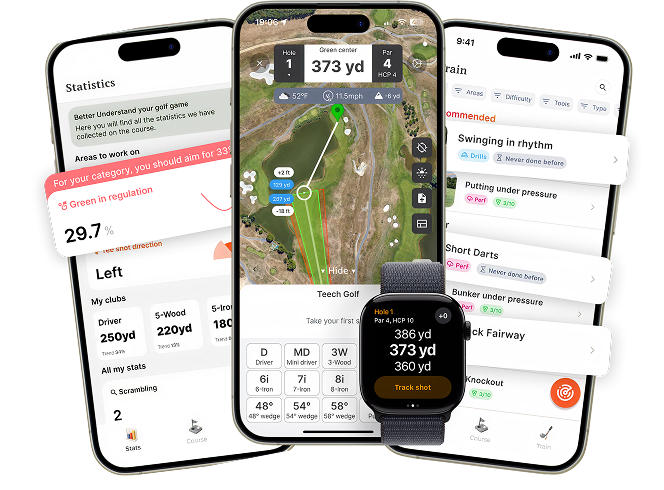
We analyze your golf statistics and performance data to tell you exactly what to work on to improve your game faster.
 Download app - free
Passionate golfer and co-founder of Teech Golf. My mission with Teech is to build technology that becomes a true companion in helping you improve your game.