




Master the Art of Wedging: A 3-Step Guide to Improve Your Short Game, Save Pars, and Dominate Intermediate Distances with Technique, Performance, and Strategy
This article is part of our guide Bunker and short game: the guide to saving pars
Wedging is one of the most underestimated parts of amateur golf, even though it is fundamental for performing on the course. It comes into play in all situations where a full shot is not possible, but where precision is crucial: green approaches from 70 meters, getting out of tricky situations, or decisive approaches to save a score. Mastering your wedges means gaining control, confidence, and saving strokes.
1. Technique: clean contact for precise wedge shots
The descending strike: the key to good contact
To obtain a low trajectory with spin and maximum control, one of the fundamental principles of wedging is to strike the ball downwards.
Contrary to the natural instinct to “lift” the ball, you must rather seek to crush the ball against the ground, keeping your hands slightly ahead at impact.
🎯 Goal: a firm contact, the ball leaving with a clear sound, and sticking to the clubface for a fraction of a second.
Technical tips for better contact:
- Ball position slightly back from center
- Weight on the front leg at address
- Keep your head stable during the swing
- Do not try to accelerate with your hands, but let your body turn
2. Performance: find your method for controlling distance
Control distances without complexity
There is no single truth to gauge wedge shots. Every player must find their method, the one that brings consistency. What matters is to choose a reference variable and stick to it.
Here are the 3 possible levers to adjust distance:
- 🫴 The grip height: the lower you go on the grip, the less power you have.
- 🕙 The swing amplitude: half, three-quarters, or full swing.
- 💨 The swing speed: the more you relax or accelerate, the more the distance varies.
Recommendation for beginners:
Choose one variable only and stick to it.
For example: keep the same speed and grip, and vary only the swing amplitude.
Next? Practice until it becomes automatic.
The goal: to have a reliable feel for distance without needing to think about it.
3. Strategy: build your distance chart
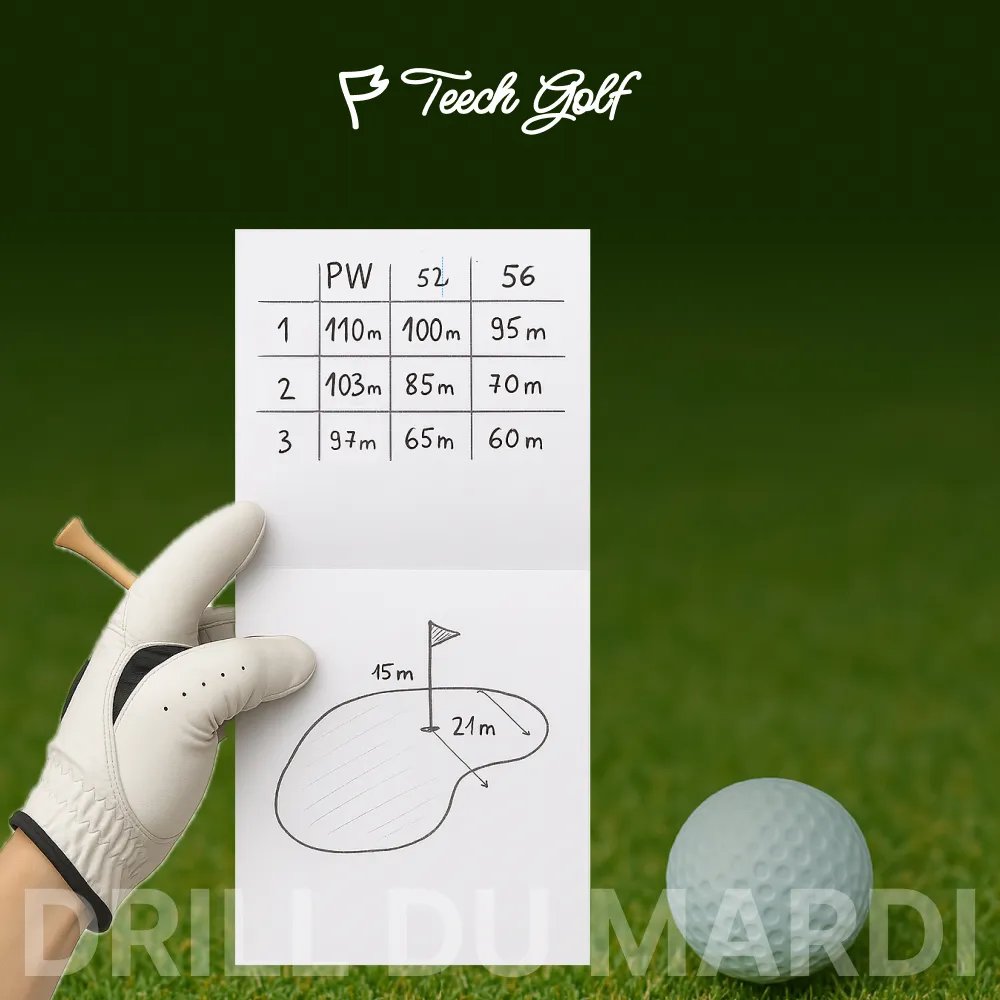
3 wedges x 3 amplitudes = 9 shots to master
The most effective method to structure your wedge game is to build a personalized matrix. Just take your 3 wedges (for example Pitching Wedge, 52°, 58°), and execute:
- A half swing
- A three-quarters swing
- A full swing
For each configuration, measure the actual distance traveled by the ball.
This gives you 9 reference distances: a true dashboard for your approaches.
Why is this powerful?
Because with this chart:
- You know what to play at 48m or 73m without thinking.
- You gain confidence and speed of decision-making.
- You can practice specifically on each target shot.
How to integrate this training?
- Schedule wedging sessions focused only on these 9 shots.
- Reproduce the same conditions (ball, lie, wind) at each session.
- Keep a notebook of distances updated with your progress.
👉 A good player never guesses: he knows his numbers.
Conclusion: master distances to score
Wedging is not reserved for pros. It is a skill accessible to all motivated players. By working methodically, building your own control system, and repeating the right gestures, you will:
- Gain strokes on difficult holes
- Save pars where others give up
- Approach the flags more often
The key? A simple, structured, and personalized approach to your game.
Wedging is a powerful lever to improve your handicap, hole after hole.